
Why do we celebrate 'Republic Day'?
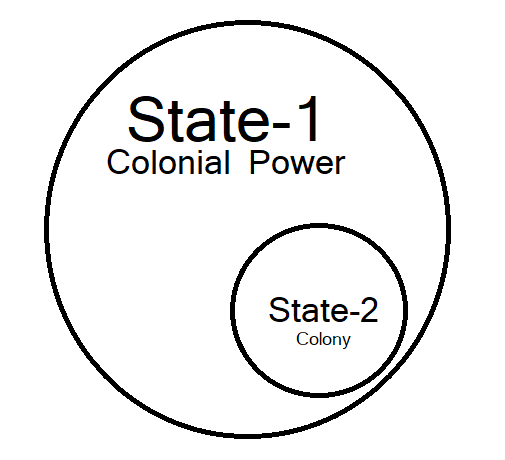
1. Colony
Whenever a more powerful state (country) controls another state in all aspects of administration, the less powerful state is said to be colonised, and the colonised state is known as a colony.
For example, we can say that Britain (a more powerful country) brought India (a less powerful country) under its control in every aspect of administration. This means that all the organs of government—(1) Legislature, (2) Executive, and (3) Judiciary—were under the control of the British government. Therefore, in the case of Britain and India, we can say that India was a colony of Britain.
There is an alternative term for the word colony, namely dependency. Hence, in other words, we can say that India was a dependency of Britain.
Note: In the language of Political Science, the term State refers to a country.
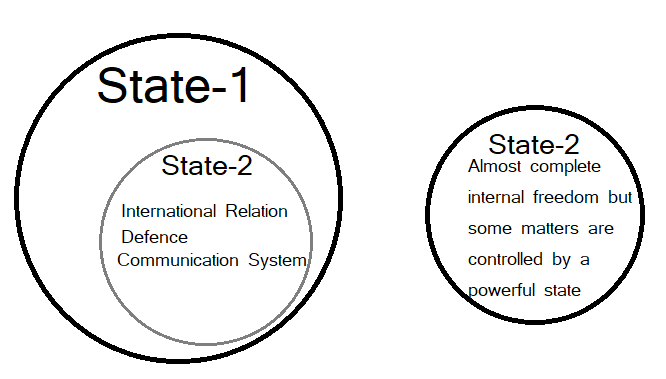
2. Protectorate
In the case of a protectorate, a less powerful state enjoys almost complete internal freedom, but some important matters—such as international relations, defence, and communication systems—are controlled by a more powerful state.
For example, before 1975, Sikkim was not a state of India; at that time, it was a protectorate of India. In 1975, a plebiscite was held in Sikkim, and since then, Sikkim has become a state of India.
3. Dominion
While studying the Indian freedom struggle, we often come across the term “Dominion State.” Let us now understand the concept of a dominion state.
In the case of a dominion state, both states (countries) are politically independent. However, the state with comparatively less power does not have its own Head of State in official documents. Instead, the Head of State of the more powerful country is recognised as the Head of State of the dominion.
Although the Head of State of the more powerful state (country) does not interfere in the administration of the dominion state, but in official documents the Head of State of the dominion state is the same person who is the Head of State of the more powerful state (country).
So, at the time of giving independence i.e. on 15th August, 1947 India was not given complete independence. It was only ‘Dominion Status’. In other words we can say that India was the Dominion of Britain.
(Here we get confused, we assume Dominion Status as ‘Complete Freedom’ or ‘Complete Independence’)
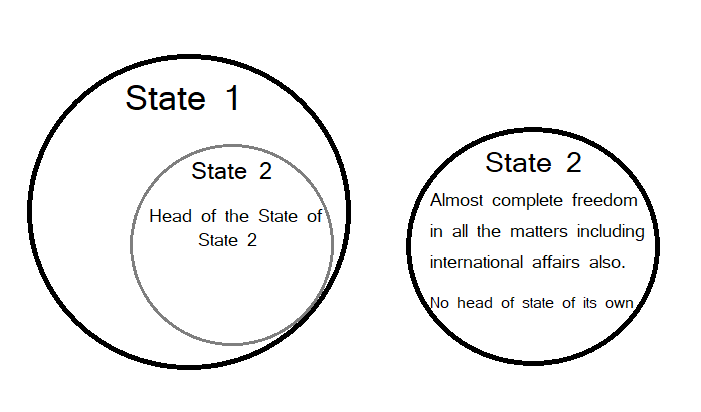
Dominion Status
Head of the state of State-2 is the same person who is the head of the state of State-1
4. Sovereign State
A sovereign state is a country that has full and independent authority to govern itself without being controlled by any other country. At this stage, a country gains complete freedom both internally and internationally. Such a country can formulate its internal and foreign policies without any external interference.
In political science, this condition is known as sovereignty. When a country attains sovereignty, it is often referred to as a republic, where the head of state is elected or appointed according to the country’s constitution and is not a monarch. In the case of India, the post of the Governor-General was abolished on 26th January 1950, and India adopted its own head of state, the President of India, after becoming a republic.
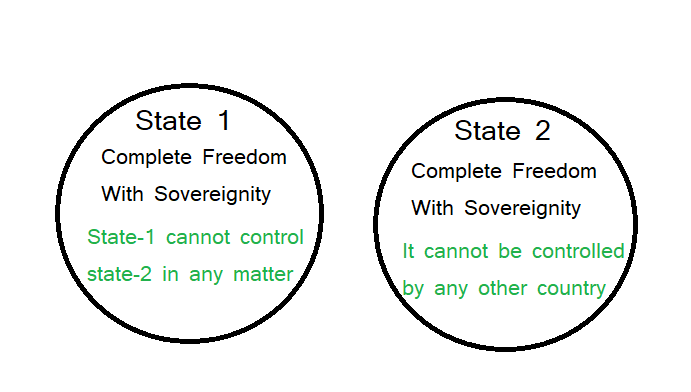
Sovereign State
India became Republic on 26th January 1950. The post of the Governor General was abolished and Dr. Rajendra Prasad became the head of state as an interim President.